

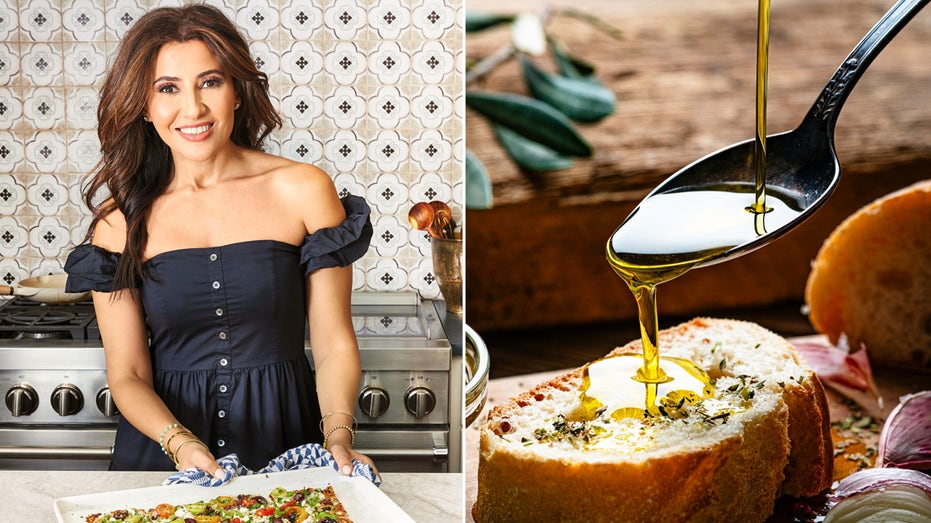
In a world of complicated diet rules and trending weight-loss drugs, one Mediterranean cooking expert says the answer could already be in your pantry.
“Extra virgin olive oil — we call it our liquid gold, and I can’t live without it,” said Suzy Karadsheh, founder of The Mediterranean Dish brand and website.
“It’s the one thing that I reach for all the time, and it’s one of the main reasons the Mediterranean diet is really good for heart health. You make that one swap, and you start using extra virgin oil for your fat, and you’ve just upgraded your diet by a lot, simply because you went from maybe saturated fats or something more processed to this liquid gold.”
YOU MAY BE EATING KALE ALL WRONG AND MISSING OUT ON KEY NUTRIENTS, RESEARCHERS WARN
Karadsheh grew up along the Mediterranean coast of Egypt and is now based in the Atlanta area. She’s the author of two New York Times bestselling cookbooks and the founder of a curated line of Mediterranean pantry staples. Her cooking centers on vegetables, legumes, whole grains, fish and healthy fats — especially olive oil.
“People used to comment on how much olive oil I’m putting on top of my salad,” she said. “I would always say, ‘One day, one day, you’ll know.'”
Rich in polyphenols and other beneficial compounds, olive oil can support overall health and promote fullness, she told Fox News Digital in an interview.
Some people in wellness circles have gone further, calling olive oil a “natural GLP-1” — referencing glucagon-like peptide-1, a gut hormone that helps regulate blood sugar, slow digestion and promote fullness.
OLIVE OIL SHOT CRAZE EXPLODES ONLINE, BUT DOCTOR WARNS IT’S ‘MORE HYPE THAN MEDICINE’
GLP-1 is the same hormone targeted by popular weight-loss drugs such as Ozempic and Wegovy.
“I’m not making any claims that that’s the case, but I’m just saying that people are starting to catch on to the fact that healthier fats are helpful to you, because otherwise you may be trying to fill up from other sources and reaching for those ultra-processed snacks throughout the day,” Karadsheh said.
GLP-1 is naturally released in the gut after meals and stimulates insulin while reducing glucagon, helping to regulate blood sugar.
The hormone also slows digestion, enhancing satiety, according to a 2021 review published in the International Journal of Molecular Sciences.
Certain nutrients — including protein, fiber and long-chain fatty acids — can stimulate GLP-1 release. Human studies cited in that review found that meals rich in olive oil produced higher post-meal GLP-1 responses than butter-rich meals, suggesting unsaturated fats, such as olive oil, may stimulate the hormone more effectively than saturated fats.
COMMON KITCHEN STAPLES COULD TRANSFORM YOUR HEALTH IN UNEXPECTED WAYS, STUDIES SHOW
Earlier animal research, including a 2005 study published in Endocrine, found that rats fed an olive oil–enriched diet had higher GLP-1 levels and improved glucose tolerance.
But experts caution against overstating any comparison to prescription GLP-1 drugs.
“The olive oil–GLP-1 connection is real but routinely overstated,” said Dr. John La Puma, a California-based board-certified internist, professionally trained chef and author of the upcoming book “Indoor Epidemic.”
“Olive oil GLP-1 release lasts minutes to hours, versus days for the drugs.”
La Puma added that several human studies show meals with olive oil and avocado produce greater releases of GLP-1 and peptide YY (PYY), another hormone that helps signal fullness, than meals high in solid fats. He cautions against reducing complex biology to a single ingredient.
CLICK HERE TO SIGN UP FOR OUR LIFESTYLE NEWSLETTER
“Calling any single food a ‘natural GLP-1’ misleads people,” he said. “What people can do is build environments — a food environment, a movement environment, a light environment — where their biology works the way it evolved to work. We need to fix the environment that broke people’s biology in the first place.”
Joseph Zucchi, a New Hampshire–based physician assistant who specializes in obesity medicine, agreed there is “a small kernel of truth” to the olive oil claim, but the effect is short-lived.
CLICK HERE FOR MORE LIFESTYLE STORIES
“Certain foods, including fats like olive oil, can stimulate the body to release GLP-1 after a meal,” he said. “But the body’s own GLP-1 is extremely short-lived. It circulates for about one to two minutes before it is broken down.”
GLP-1 medications, meanwhile, are engineered to remain active in the body for up to a week.
“A brief dietary GLP-1 signal after a meal simply does not produce the same sustained effect,” Zucchi said. He noted that olive oil still plays an important role in metabolic health when it replaces saturated or ultra-processed fats.
That idea of replacement is exactly where Karadsheh says people should focus.
TEST YOURSELF WITH OUR LATEST LIFESTYLE QUIZ
“A little bit more olive oil on your salad makes it that much more of a meal,” she said. “I actually need the fat in order to stay satisfied for longer.”
She even takes a shot of olive oil every morning, she said. Still, she agrees that making healthy swaps and pairing it with a balanced diet are where the real impact lies.
“It’s not about eliminating,” she said. “It’s about upgrading.”