

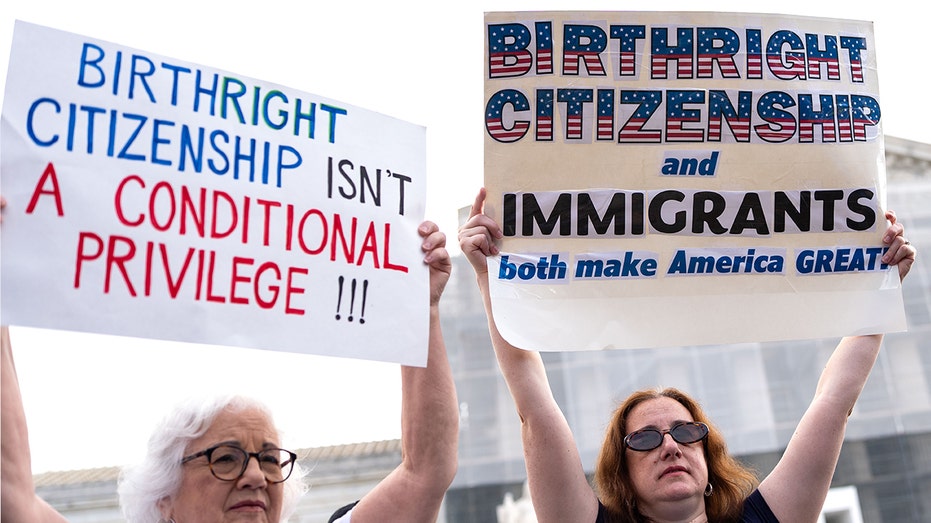
From the moment President Trump issued his executive order on birthright citizenship, critics derided it with a litany of adjectives nearly as colorful as they were unwarranted.
It was racist. Ahistorical. Unprecedented. Un-American.
During oral arguments at the Supreme Court last week, Justice Elena Kagan appeared to add another pejorative to the catalogue: revisionist.
Kagan’s accusation was, to be sure, more professionally dressed than many of the others. But it’s equally erroneous.
TRUMP’S BIRTHRIGHT CITIZENSHIP CRUSADE DRAWS BACKING FROM COHORT OF PROMINENT LEGAL SCHOLARS
Solicitor General John Sauer wasted no time pushing back on Kagan’s characterization, which, in its specific context, was limited to the government’s contention that birthright citizenship for the U.S.-born children of illegally or temporarily present aliens remained an open question even after the Supreme Court’s 1898 decision in United States v. Wong Kim Ark.
Sauer pointed out the irony of Kagan’s characterization: the modern “consensus” that Wong Kim Ark settled these questions is the revisionist interpretation. The federal government only definitively adopted this view of Wong Kim Ark in the 1930s. And it did so at the prompting of a single senior State Department official who had earlier admitted in a law review article that his opinion was contrary to that of the general legal community.
Sauer’s response hits on a truth that cannot be repeated enough to the American public: Much of the prevailing modern assumption about “universal” birthright citizenship is based on a revisionist interpretation. The view exists as the “consensus” today only because it won out in a hostile takeover, supplanting an original, and far more limited, understanding of the scope of the Fourteenth Amendment’s Citizenship Clause.
INSIDE SUPREME COURT: HOW TRUMP HEARD BIRTHRIGHT CITIZENSHIP ARGUMENTS
Consider the ACLU attorney’s reference during oral argument to an 1896 State Department regulation that defined birth on U.S. soil as the sole requirement for birthright citizenship, excepting only the children of tribal Indians and foreign diplomats. Yes, that policy existed. It was apparently implemented during the latter half of President Grover Cleveland’s second term. But it was, itself, a revisionist policy: It broke not just from the policies of earlier administrations, but from the policy articulated by the executive branch during Cleveland’s own first term.
In 1885, Cleveland’s first secretary of state, Thomas Bayard, had instructed federal officials not to issue an American passport to a man whom all parties agreed had been born in the United States to parents who weren’t ambassadors. Bayard concluded that the man, Richard Greisser, wasn’t a U.S. citizen, despite having been born in Ohio, because his German father and Swiss mother had never established permanent residency in the United States. In fact, they’d returned with Richard to Germany within a year of his birth and raised him there as a German subject. In stark contrast to the regulation issued more than a decade later, the first Cleveland administration declared that Greisser had been, at the time of his birth, “subject to a foreign power” and not “subject to the jurisdiction of the United States,” as required by the Fourteenth Amendment’s Citizenship Clause.
Bayard’s position on birthright citizenship for the children of temporarily present aliens was the normative policy at the time. His predecessor under President Chester Arthur, Frederick Frelinghuysen, had similarly instructed federal officials not to issue citizenship documents to U.S.-born Ludwig Hausding. Like Greisser, Hausding was the son of “Saxon subjects” who were “only temporarily in the United States” and who raised him in Germany from infancy. Frelinghuysen’s State Department was clear that the mere “fact of birth [on U.S. soil], under circumstances implying alien subjection, establishes of itself no right of citizenship.” The immigration status of Hausding’s parents at the time of his birth made his claims to birthright citizenship “untenable.””
EXPERT FLAGS ‘DISAPPOINTING’ QUESTIONS FROM JUSTICES IN TRUMP BIRTHRIGHT CITIZENSHIP CASE
In 1890, State Department officials under Benjamin Harrison demonstrated their continued reliance on this operative theory of birthright citizenship, rejecting citizenship claims for a child born in a New York hospital to Mary Devereaux, a would-be immigrant mother awaiting a final determination of her eligibility to enter the country. The Irish mother had become ill while being held aboard a British ship in New York Harbor and was permitted to disembark for treatment at a New York hospital until after she gave birth.
The State Department concluded that both mother and child were eligible for deportation because the child, though born on U.S. soil, was not born “subject to the jurisdiction of the United States, in the sense of the [F]ourteenth [A]mendment.” It also noted that this decision was consistent with the opinion of renowned legal scholar Francis Wharton, who wrote in his treatise that the same reasoning which excludes tribal Indians from birthright citizenship “would exclude the children born in the United States to foreigners here on transient residence.”
CLICK HERE FOR MORE FOX NEWS OPINION
Whatever may have led to the 1896 change in State Department policy, it was, indeed, a change — a revision — of the earliest executive branch policies based on the earliest executive branch understandings of birthright citizenship.
Those earliest executive branch interpretations of the Citizenship Clause are interchangeable with the allegedly “revisionist” theory now defended by the Trump administration. And the resultant policy lines drawn about who is or is not a citizen by birth are effectively the same.
The Trump administration’s efforts to abide by the original public meaning of the Fourteenth Amendment aren’t revisionist. They’re just restorative.
To the originalist, no distinction in words could matter more.