

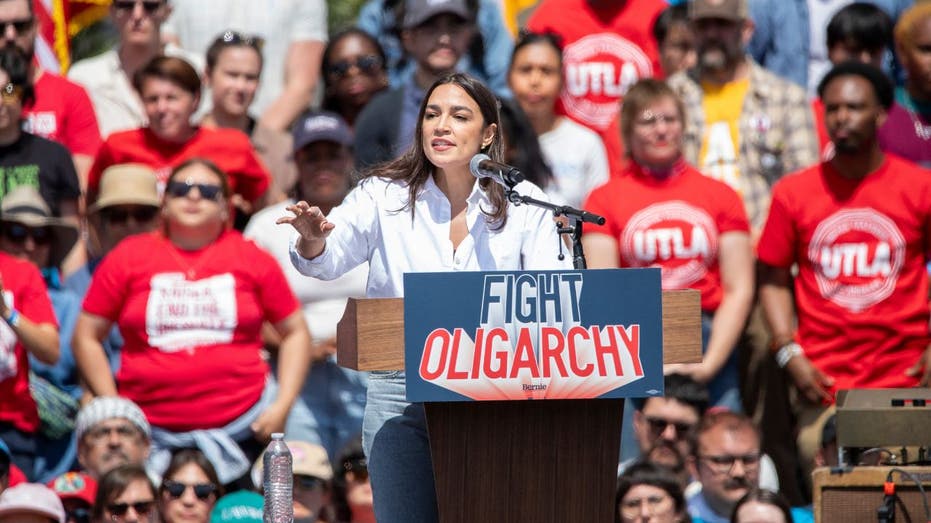
If you listen to politicians like Vermont Independent Sen. Bernie Sanders and New York Democrat Rep. Alexandria Ocasio-Cortez, there’s a constant drumbeat. The rich don’t pay their “fair share.” and we don’t need any “oligarchs.” These are powerful soundbites. They are also among the most intellectually lazy phrases in modern economics.
Because here’s the real question no one answers: what exactly is “fair?”
Let’s start with the facts which many people don’t like to discuss and not feelings.
According to data from the Internal Revenue Service and the Tax Foundation, the top 1% of earners already pay roughly 40% or more of all federal income taxes. The top 10%? Closer to 70%. Meanwhile, nearly half of Americans pay little to no federal income tax each year.
So, when someone says the wealthy don’t pay enough, what they’re really saying is: It’s fair that lots of people pay zero and that they want the rich to pay even more than that share.
But here’s where the conversation gets completely detached from reality, because federal income tax is just the starting line, not the finish line, when we talk about overall taxation.
Let’s walk through what “rich” Americans actually pay in taxes.
DOGE REVEALS WHAT YOU GET FOR THE HALF MILLION YOU’LL PAY IN TAXES OVER YOUR LIFETIME
This is the headline number everyone debates. Top earners face marginal rates up to 37%, before you even layer in surtaxes.
Live in high-tax states like California or New York, and you can add another 10%–14% on top of that federal number. Suddenly, you’re pushing toward a combined rate that rivals some European countries.
Congratulations, you’re writing a check every year just to keep it. In states like New Jersey or Texas, property taxes can easily hit $10,000 to $30,000+ annually for higher-value homes. We are talking 1% to 2% of your home value beyond some states that have personal property taxes.
STEVE FORBES: DON’T CRUSH HOMEOWNERS TO PAY FOR NYC’S OUT-OF-CONTROL BUDGET
Every time you spend, you’re taxed again. In places like Tennessee or Washington, combined sales taxes approach 10%. That’s post-income-tax money being taxed all over again. This sparks the great debate of a fair tax or having a VAT tax or what some will call a consumption tax.
Invest wisely? You’ll pay for that as well. Federal capital gains rates, plus the Net Investment Income Tax, can push you over 23.8%, before state taxes take another bite. This is after you tax after-tax money, invest it well, and then pay tax again. This also affects business owners who build their business for years and pay tax on distributable income all along the way only to potentially be taxed at the highest marginal tax rate when they sell the business that created jobs for people for decades.
Build wealth over a lifetime? The government may take another bite out of the apple when you pass it on to your heirs. While this doesn’t affect as many people, it can be significant for wealthy families.
JONATHAN TURLEY: SANDERS’ WEALTH TAX DANGLES CHECKS WHILE TORCHING THE CONSTITUTION
Now let’s pause and ask the captain obvious question: At what point is it enough?
Is “fair” when the top 1% pays 50% of all taxes? 60%? 80%? Does any politician who makes these outlandish statements have a real number? No. The reason? You can’t get blood from a stone from people who don’t pay at all right now.
We’re already operating in a system where such a small percentage of Americans fund the majority of government spending.
Here’s what makes this debate even more frustrating, and that is, “fair share” is never defined. It’s a moving target. The more you pay, the more you’re told you should pay.
That’s not tax policy, that’s the modern politics of today.
And let’s be clear that this isn’t about defending billionaires. It’s about defending math, incentives, and, most importantly, capitalism.
AMERICA’S $39 TRILLION DEBT BOMB COULD BE MORE PAINFUL THAN YOU THINK
When you continually raise the burden on the most productive individuals and business owners, you don’t just “tax the rich.” You change the behavior of the very people who create the system. They create the jobs. They create the innovation. They create the future of America. You discourage investment. You slow hiring. You reduce risk-taking, which are the very things that drive our GDP.
CLICK HERE FOR MORE FOX NEWS OPINION
America clearly needs more revenue as the time ticks toward $40 trillion of debt. It also has a significant spending problem.
Before we demand more from taxpayers, maybe we should demand more accountability from Washington.
Until someone can clearly define what “fair share” actually means in real dollars, real percentages, and real outcomes, it remains exactly what it is today.
A soundbite and a slogan. And those two things don’t balance our budget.